What Is Digital Orthodontics? Understanding the Technology Revolution in Teeth Straightening
Digital orthodontics refers to the use of 3D imaging, artificial intelligence, and computer-aided design to diagnose and treat orthodontic conditions. These technologies are changing every step of treatment, from initial scans to final results. Instead of relying on plaster molds and manual measurements, today's orthodontists use intraoral scanners, cone beam computed tomography (CBCT), and AI-driven software to create precise treatment plans designed around each patient's unique anatomy.
If you've ever had dental impressions taken the old-fashioned way, you probably remember the ordeal. A tray filled with goopy putty pressed against your teeth for what felt like forever. You might have gagged. You definitely didn't enjoy it. And after all that discomfort, the resulting mold still had limitations when it came to accuracy.
That process is rapidly becoming a thing of the past.
The Shift from Analog to Digital Orthodontics
The shift from analog to digital orthodontics means that manual impressions, hand-traced X-rays, and experience-based predictions are being replaced by precise digital scans, 3D imaging, and AI-assisted treatment planning, resulting in faster, more accurate care.
Traditional orthodontic workflows involved several manual steps. Orthodontists would take plaster impressions, trace cephalometric X-rays by hand, and rely heavily on their training to predict how teeth would move over months or years of treatment. Skilled clinicians achieved excellent dream smiles with these methods. But the process was time-consuming and left room for human error.
Modern digital orthodontics changes this equation entirely. Here's what the technology looks like today:
Intraoral Scanners capture rapid-fire images, creating detailed 3D models of your teeth and gums in about 60 seconds. No putty. No gagging. Just a small wand that moves around your mouth.
Cone Beam CT (CBCT) Imaging provides a full 3D view of teeth, roots, jawbone, and even airways. This level of detail was impossible with traditional 2D X-rays.
AI-Driven Treatment Planning analyzes scan data and proposes the best tooth movement sequences based on large databases of previous cases.
3D Printing and CAD/CAM Fabrication produces custom aligners, brackets, and wires designed specifically for your teeth.
3D Scans, CBCT, and AI: Working Together in Digital Orthodontics
The real advantage is how these technologies connect. Your intraoral scan, CBCT images, and photographs all feed into a single digital platform. AI software can analyze this combined data to identify issues that might be missed when looking at each piece separately.
For example, CBCT imaging reveals root positions and bone density that surface scans can't capture. When AI analyzes both together, it can predict how teeth will respond to specific forces and flag potential complications before treatment begins.
All of this data in one place means fewer surprises during treatment. More predictable outcomes. And a treatment plan that's personalized to your smile from the very start.
AI Treatment Planning: Powerful but Not Autonomous
These tools are incredibly sophisticated, but they don't work on their own. AI can analyze data and suggest treatment approaches, but an experienced orthodontist makes the final decisions.
The American Association of Orthodontists emphasizes this point: digital tools enhance diagnostic capabilities and treatment precision, but the orthodontist's training, judgment, and relationship with the patient remain central to successful outcomes.
Think of it this way: a GPS can calculate the fastest route to your destination, but you still need a driver who understands road conditions, traffic patterns, and when to take a detour. AI in orthodontics works similarly. It processes vast amounts of data quickly. The orthodontist interprets that information and makes decisions based on years of specialized training.
How Digital Orthodontic Technology Works Step by Step
Understanding what happens at each stage of digitally planned treatment can help you appreciate why these technologies matter. Here's the process from start to finish.
Digital Impressions Replace Messy Molds
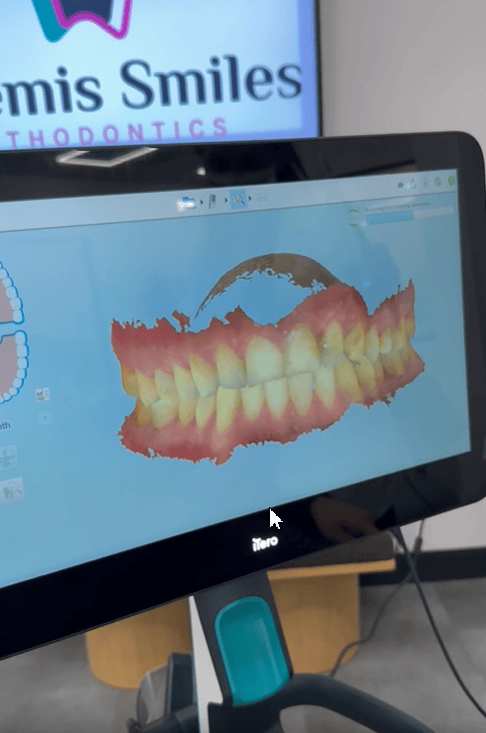
Your first visit starts with an intraoral scan. A team member passes a small wand around your mouth while a screen displays a 3D model building in real time. The entire process takes about 60 seconds.
iTero scanners, used at many modern orthodontic practices including Artemis Smiles Orthodontics, capture thousands of frames per second. The result is a highly detailed digital model of your teeth, gums, and bite. You can even see the model on screen right after scanning.
No impression material. No waiting for molds to set. No risk of distorted impressions that require retakes.
The digital file is also permanent and easy to share. If you need a replacement retainer years later, your orthodontist can fabricate one from the original scan without bringing you back for new impressions. That kind of long-term convenience matters.
3D CBCT Imaging Maps Everything Beneath the Surface
For many patients, the next step involves CBCT imaging. This technology captures a full 3D view of your oral structures in a single, quick scan.
Unlike traditional X-rays that show flat, 2D images, CBCT reveals:
- Tooth roots and their positions within the jawbone
- Bone density and volume in different areas
- Jaw joint (TMJ) anatomy
- Airway dimensions that might affect breathing
- Impacted teeth that haven't erupted yet
- Sinus positions relevant for upper tooth movement
A full picture like this helps orthodontists plan treatment that accounts for what's happening beneath your gum line, not just what's visible on the surface.
CBCT also uses significantly less radiation than multiple traditional X-rays would require to gather similar information. According to the American Dental Association, modern CBCT units deliver radiation doses comparable to a few days of natural background exposure. That's a meaningful safety improvement.
AI Analyzes Your Scans and Proposes Treatment
Once your digital records are complete, AI-powered software goes to work. These systems analyze your scans using algorithms trained on large databases of orthodontic cases.
The AI evaluates:
- Current tooth positions and angles
- Available space in each arch
- Bite relationships between upper and lower teeth
- Root positions and bone support
- Predicted tooth movement responses
Based on this analysis, the software generates a proposed treatment plan showing exactly how each tooth should move, in what sequence, and with what type of force.
Some systems even create animated simulations showing your teeth moving from their current positions to their final alignment. You can see the expected outcome before anything actually happens in your mouth. Many patients find this reassuring and motivating.
Your Orthodontist Reviews and Refines the AI Plan
Clinical expertise becomes essential at this stage. Your orthodontist reviews the AI-generated plan with a critical eye, looking for:
- Movement sequences that might stress certain teeth
- Timing adjustments based on patient-specific factors
- Modifications needed for comfort or lifestyle considerations
- Refinements based on their experience with similar cases
They might adjust a treatment plan to account for a patient's upcoming wedding. Or a college student's exam schedule. Or a child's growth patterns. AI doesn't know about these factors unless the clinician incorporates them.
An experienced clinician also recognizes when a plan needs modification because teeth don't always respond exactly as predicted. Movements that look good on screen can sometimes be problematic in practice.
Custom Appliances Built with CAD/CAM and 3D Printing
Traditional orthodontic appliances were largely standardized. Brackets came in predetermined sizes, and orthodontists selected the closest match for each tooth.
Digital fabrication changes this completely.
Custom Aligners: Each aligner in your series is designed specifically for your teeth at a particular stage of treatment. 3D printing or thermoforming creates aligners that fit precisely.
Custom Brackets: Systems like LightForce use 3D printing to create brackets designed for each individual tooth's anatomy. The bracket base curves to match your exact tooth surface, and the prescription is built into the bracket design.
Custom Wires: Some systems even create archwires with bends pre-programmed based on your digital treatment plan.
Appliances built this way fit better, work more efficiently, and typically require fewer adjustments. Big difference from the one-size-fits-most approach.
AI-Assisted Monitoring Tracks Your Progress
Treatment doesn't end when you walk out with your aligners or braces. Modern orthodontics includes ongoing monitoring to make sure everything proceeds as planned.
Remote monitoring systems allow patients to submit photos or scans from home. AI analyzes these images to check:
- Whether aligners are tracking properly
- If any teeth are moving slower than expected
- When it's appropriate to advance to the next aligner
- Whether an in-practice visit is needed
Fewer routine visits for progress checks is the practical outcome. You only come in when there's actually something that needs attention.
For patients with busy schedules, this efficiency is a real benefit. College students away at school, professionals who travel frequently, and families juggling multiple schedules all appreciate fewer trips to the orthodontist's practice.
7 Ways Orthodontic Technology Benefits Patients Today
Technology in orthodontics isn't about impressing patients with cool gadgets. These tools deliver real, measurable benefits that affect your treatment and your dream smiles.
1. Better Diagnostic Accuracy
Digital scans capture detail that traditional impressions simply cannot match. Intraoral scanners produce measurements with sub-millimeter precision, significantly more accurate than plaster models.
Why does accuracy matter so much? Orthodontic treatment involves moving teeth in very specific ways. A fraction of a millimeter can be the difference between a perfect bite and one that needs adjustment. When your starting point is captured with greater precision, every step after that benefits.
2. Shorter Treatment Times for Many Patients
When treatment is planned using AI, tooth movements happen in the most efficient sequence possible. The software calculates how to reach your final alignment with the fewest steps and least amount of overall force.
For many patients, this efficiency translates to shorter treatment times. Every case is different. But digitally planned treatment often gets dream smiles faster than traditional approaches because movements are planned well from the start rather than adjusted along the way.
3. A More Comfortable Treatment Experience
Remember those impression trays? Gone. No gagging or discomfort during records. Custom-fit appliances reduce irritation and pressure points. Well-calibrated force levels mean teeth move efficiently without excessive discomfort. And fewer adjustments mean fewer visits where things feel tight or sore.
Patients who remember traditional impressions are often amazed at how quick and easy digital scanning feels. Those with strong gag reflexes find the whole thing completely different from what they expected.
4. See Your Dream Smile Before Treatment Starts
One of the most exciting benefits of digital orthodontics is the ability to visualize your dream smiles before treatment begins. 3D simulations show your teeth moving through each stage of treatment to their final positions. You can see what your smile will look like when you're done.
These simulations are based on your actual anatomy rather than generic models. What you see is a realistic prediction of your specific outcome. Patients tell us this visualization helps them feel confident about their decision to get started and stay motivated throughout the process.
5. Fewer Office Visits Required
Remote monitoring technology means you don't need to come in as often for routine progress checks. AI can analyze photos or scans you submit from home and determine whether everything is on track.
Busy professionals who can't easily take time off work find real value here. So do students away at college and families managing multiple schedules. When you do come in, it's because there's something specific to address, not just for a quick look that confirms everything is fine.
6. Safer Diagnostic Imaging
CBCT technology provides full 3D imaging with radiation doses comparable to a few days of natural background exposure. Compared to the cumulative radiation from multiple traditional X-rays needed to gather similar diagnostic information, the reduction is significant.
For patients concerned about radiation exposure, particularly parents making decisions for their children, this safety improvement is meaningful. You get better diagnostic information with less exposure. That matters.
7. Digital Records That Last a Lifetime
Digital records don't degrade over time like plaster models. Your scan from day one of treatment remains perfectly preserved indefinitely.
Need a replacement retainer? Your original scan is ready. Moving and need records for a new dentist? Already available. Want documentation for insurance purposes or comparison images showing your treatment progress? Your complete digital record is always accessible, exactly as it was captured. This is one of those benefits patients don't think about until they need it, and then they're grateful it exists.
Traditional Orthodontics vs. Digital Orthodontics
Understanding the specific differences between traditional and digital approaches helps you appreciate what modern technology offers. Here's how they compare across key aspects of treatment.
Impressions: Putty Molds vs. Digital Scans
| Aspect | Traditional Impressions | Digital Scans |
|---|---|---|
| Process | Putty-filled trays held in mouth for 2-4 minutes | Wand passed around mouth for 60 seconds |
| Comfort | Often causes gagging; uncomfortable for many | No discomfort; no gag-inducing materials |
| Accuracy | Subject to distortion, air bubbles, tearing | Sub-millimeter precision; consistent results |
| Retakes | Common due to errors; requires repeating process | Rare; any issues visible immediately |
| Storage | Physical models require space; can break or degrade | Digital files stored indefinitely; easily shared |
For patients who've been through traditional impressions, the difference is striking. Many describe digital scanning as "actually pleasant" compared to what they expected.
Imaging: 2D X-Rays vs. 3D CBCT
| Aspect | Traditional 2D X-Rays | CBCT 3D Imaging |
|---|---|---|
| View | Flat images from limited angles | Full 3D model viewable from any angle |
| Detail | Overlapping structures can obscure information | Clear visualization of all structures |
| Root visibility | Limited; often unclear | Full view of root positions and lengths |
| Airway assessment | Not possible | Full airway analysis included |
| Radiation | Multiple exposures may be needed | Single scan captures everything |
The diagnostic value of 3D imaging is substantial. Orthodontists can identify issues that would be invisible on traditional X-rays and plan treatment that accounts for what's happening beneath the surface.
Treatment Planning: Manual vs. AI-Assisted
| Aspect | Traditional Planning | AI-Assisted Planning |
|---|---|---|
| Analysis method | Manual measurements and tracings | Automated analysis of thousands of data points |
| Time required | Hours of manual work | Minutes of processing plus clinical review |
| Consistency | Varies based on individual clinician | Standardized analysis with clinical refinement |
| Visualization | 2D drawings and verbal descriptions | 3D animations showing predicted movement |
| Optimization | Based on experience and judgment | Algorithm-driven movement sequences |
AI doesn't replace clinical judgment. It provides a sophisticated starting point that your orthodontist then refines based on experience and patient-specific factors.
Appliances: Stock vs. Custom-Fabricated
| Aspect | Traditional Appliances | Digitally Fabricated Appliances |
|---|---|---|
| Brackets | Selected from standard sizes | 3D-printed to match each tooth exactly |
| Aligners | N/A for braces | Custom-designed for each treatment stage |
| Fit | Approximate; may require adjustment | Precise; designed from your exact scan |
| Efficiency | Good, but limited by standardization | Built for your specific anatomy |
Custom fabrication means appliances work more efficiently from day one. Less time is spent adjusting for fit issues because the fit is designed in from the start.
Monitoring: In-Office Only vs. Remote Plus In-Office
| Aspect | Traditional Monitoring | Modern Monitoring |
|---|---|---|
| Check frequency | Every 4-8 weeks in the practice | Remote checks between fewer practice visits |
| Method | Visual examination by orthodontist | AI analysis of submitted photos plus in-practice visits |
| Response time | Issues found at next visit | Problems flagged immediately |
| Convenience | Requires practice visits for all checks | Many checks done from home |
Remote monitoring doesn't eliminate practice visits entirely. It reduces the number of routine visits while making sure problems are caught quickly.
Does High-Tech Orthodontic Treatment Cost More?
Digital orthodontic treatment does not necessarily cost more than traditional methods. Efficiency gains from AI planning, fewer visits, and shorter treatment times often offset technology investments, making costs comparable for most patients.
Cost is a reasonable concern for anyone considering orthodontic treatment. You might assume that all this technology must come with a premium price tag. The reality is more nuanced than that.
Technology Can Actually Reduce Overall Costs
While practices invest significantly in digital equipment, that investment often translates to efficiencies that benefit patients:
Shorter treatment times mean fewer months of active treatment and fewer total visits.
Fewer adjustment visits reduce the time both you and the practice spend on routine checks.
More predictable outcomes mean fewer surprises that require additional treatment.
Remote monitoring reduces the number of in-practice visits needed.
These efficiencies can offset the cost of technology, meaning digitally planned treatment isn't necessarily more expensive than traditional approaches.
What Actually Drives Treatment Costs
The primary factors affecting your orthodontic investment remain the same whether treatment uses digital or traditional methods:
Case complexity: Severe crowding, significant bite issues, or jaw discrepancies require more time and expertise to correct.
Treatment duration: Longer treatment naturally costs more than shorter treatment.
Appliance type: Clear aligner treatment, braces, and other options have different pricing structures.
Geographic location: Practice costs vary by region, which affects pricing.
Provider experience: Specialists with advanced training and credentials may charge differently than general dentists offering orthodontic services.
Insurance Coverage for Digital Orthodontic Treatment
Your dental insurance doesn't care whether your orthodontist uses digital scans or plaster molds. Coverage is based on the codes and your policy's orthodontic benefit, not the technology used to deliver treatment.
If your plan covers orthodontic treatment, it covers digitally planned treatment. The tools used behind the scenes don't change your benefit.
Payment Plans That Make Treatment Accessible
Many practices offer low monthly payment plans that make treatment simple and affordable regardless of the technology involved. Payment calculators help you understand what to expect before committing. Flexible financing makes modern orthodontic care accessible to most budgets.
High-tech treatment is probably more affordable than you think, especially with flexible financing options available. Don't let assumptions about cost keep you from exploring what digital orthodontics can do for your smile.
Who Benefits from Technology-Driven Orthodontic Treatment?
Digital orthodontics isn't limited to certain types of patients or specific conditions. The benefits apply broadly across age groups and case types. Orthodontics is for everyone, and the technology reflects that.
Children: Earlier, More Precise Intervention
Children benefit from earlier, more precise intervention thanks to 3D imaging and AI growth prediction.
Here's what that looks like in practice:
- CBCT imaging and AI analysis can help predict how a child's jaw and teeth will develop, allowing for better-timed intervention
- 3D imaging reveals airway dimensions that might indicate breathing issues affecting facial development
- Quick digital scans are far easier for kids who might struggle with traditional impressions
- Children can see their future smile on screen, which helps them understand why treatment matters
Early orthodontic treatment (Phase I) often focuses on guiding jaw growth and creating space for permanent teeth. Digital tools help orthodontists plan these interventions with greater precision than ever before.
Teens: Faster Treatment During Busy Years
Teenagers remain the largest group of orthodontic patients. Modern technology makes their time in treatment more efficient and more motivating.
AI-planned treatment can reduce treatment duration during busy high school years. Seeing expected dream smiles on screen improves motivation and compliance. Digital planning makes clear aligner treatment more accessible for image-conscious patients. And busy schedules with school, sports, and activities are easier to manage with fewer practice visits.
Adults: Discreet, Efficient Treatment That Fits Your Life
Adult orthodontic treatment has grown significantly in recent years, and technology makes it more appealing than ever. Adult patients frequently choose discreet treatments like precisely planned clear aligners and other options for completely hidden treatment.
Shorter treatment times and fewer visits appeal to working professionals. AI helps plan treatment for cases complicated by previous dental work, missing teeth, or bone loss. Remote monitoring means you can manage treatment without frequent time away from work.
Patients with Gag Reflexes or Dental Anxiety
If traditional impressions made you miserable, digital scanning is a huge relief. No impression material. No tray pressing against the back of your mouth. No extended time with something uncomfortable sitting there.
Many patients who avoided orthodontic treatment because they couldn't tolerate impressions find that digital scanning removes this barrier entirely. The wand is small, the process is fast, and you can breathe normally throughout. It's a completely different experience.
Complex Cases Benefit Most
Some of the greatest benefits of digital orthodontics show up in complex cases:
- With severe crowding, AI can calculate the most efficient extraction or non-extraction approach
- For surgical cases, 3D planning allows orthodontists and oral surgeons to coordinate precisely
- CBCT reveals exactly where impacted teeth are located and how to bring them into alignment
- Full 3D analysis shows how upper and lower jaws relate and how to correct bite discrepancies
Busy Schedules? Technology Adapts to Your Life
If your schedule makes frequent visits difficult, modern orthodontics offers real solutions. Remote monitoring reduces routine visits. Efficient treatment means fewer total visits. Flexible scheduling at practices with modern technology often includes evening or weekend options.
Whether you're a busy professional, a parent managing multiple kids' schedules, or a student away at college, technology-driven orthodontics works with your life rather than against it.
Frequently Asked Questions About Digital Orthodontic Technology
Is a 3D Scan Painful or Uncomfortable?
Not at all. Digital scanning involves a small wand that moves around your mouth, capturing images without touching your teeth in any uncomfortable way. The entire process takes about 60 seconds, and there's no impression material, no gagging, and no discomfort.
Most patients are surprised by how quick and easy it is, especially compared to what they expected or remember from traditional impressions.
Can AI Replace My Orthodontist?
No. AI is a powerful analytical tool, but it does not make clinical decisions. Your orthodontist reviews every AI-generated treatment plan, refines it based on clinical training, and makes sure it accounts for your individual needs and preferences.
AI handles data analysis while the orthodontist provides judgment, expertise, and the human relationship that makes treatment successful.
How Accurate Is AI Treatment Planning?
AI treatment planning is generally more precise than traditional manual methods because it uses digital measurement, consistent analysis, and pattern recognition across large case databases. Specific advantages include:
Measurement precision: Digital analysis eliminates human measurement error.
Consistency: Algorithms apply the same analytical standards to every case.
Pattern recognition: AI identifies the best movement sequences based on outcomes from similar cases.
Predictive modeling: Software simulates how teeth will respond to specific forces.
That said, accuracy in orthodontics isn't just about numbers. It's about achieving dream smiles that work for each individual patient. AI provides precise analysis. The orthodontist makes sure that precision serves the patient's actual needs.
Will My Insurance Cover Treatment That Uses Digital Technology?
Yes. Insurance coverage is based on procedure codes and your policy's orthodontic benefit, not the technology used to deliver treatment. Whether your orthodontist uses digital scans or plaster molds, AI planning or manual analysis, your insurance benefit applies the same way.
How Long Does Digitally Planned Orthodontic Treatment Take?
Most digitally planned orthodontic treatments take between 6 and 24 months, depending on case complexity. Simple cases might wrap up on the shorter end, while complex cases can require the full duration or longer.
Digitally planned treatment often gets dream smiles efficiently because:
- Movement sequences are planned well from the start
- Custom appliances work more efficiently
- Problems are caught early through monitoring
- Fewer adjustments are needed along the way
Many patients find that their treatment progresses smoothly with fewer delays than they expected.
What Is an iTero Scanner and How Does It Work?
The iTero scanner is an intraoral scanning system that creates detailed 3D digital models of your teeth and gums. It uses optical technology to capture thousands of images per second as the wand moves around your mouth.
Here's how it works:
- The scanner wand is passed over your teeth, capturing images from multiple angles
- Software stitches these images together in real time
- A full 3D model appears on screen within about 60 seconds
- The digital model can be rotated, measured, and analyzed
- The file is stored permanently and can be used for treatment planning, appliance fabrication, and future reference
The result is a highly accurate digital impression that's more comfortable to create, more precise than traditional molds, and permanently stored for future use. Many orthodontic practices now consider it the standard of care for digital records and treatment planning.